

Tim Walz and Anne Frank
Restoring Moral Clarity to the Immigration Debate

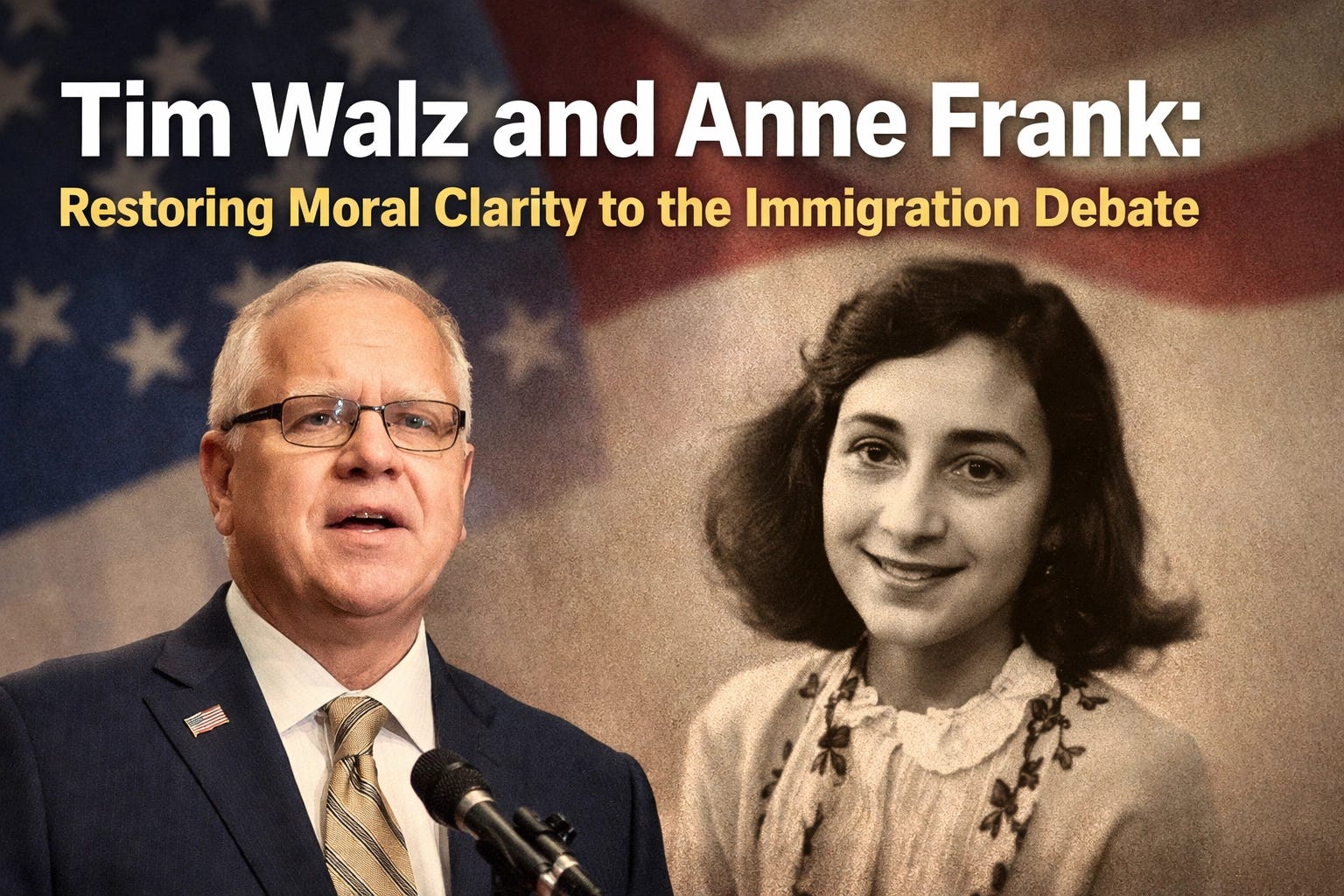
Tim Walz’s decision to invoke Anne Frank while commenting on federal immigration enforcement operations represents a failure of historical literacy so profound that it collapses moral categories that history itself labored, at immense cost, to clarify. The comparison confuses genocide with governance, racial annihilation with civil law, and totalitarian extermination with constitutional enforcement, thereby trivializing one of the gravest crimes in human history while offering zero serious illumination of the present controversy.
As Christians called to speak truth in the public square, we have an obligation to resist rhetorical manipulation that cheapens genuine suffering and distorts the moral architecture of human civilization. This moment demands that we restore clarity where confusion has been sown deliberately.
The Terror Anne Frank Actually Faced
Anne Frank did live in fear, although the source of that fear arose from a state that had transformed race into destiny and law into an instrument of extermination. In her diary, Anne records with clarity and anguish the nature of the terror closing in around her family, writing, “Our freedom was severely restricted by a series of anti-Jewish decrees,” followed by the chilling recognition that “Jews were required to wear a yellow star, Jews were required to turn in their bicycles, Jews were forbidden to use streetcars” and eventually Jews were driven into hiding simply to survive.
Her fear never arose from lawful civic enforcement applied equally to a population. Instead, it flowed from a racial program designed to erase Jewish existence from Europe altogether. The hiding in the annex was an act of survival against annihilation, rather than an attempt to evade routine civil process within a functioning constitutional order.

Viktor Frankl, who endured the camps and reflected with piercing psychological precision on the Final Solution, made explicit that the atrocities he witnessed rested entirely upon racial and religious hatred codified into state policy. In Man’s Search for Meaning, Frankl recounts that prisoners were reduced to numbers precisely because individuality itself had become a crime, writing that “the gas chambers of Auschwitz, Treblinka, and Maidanek were ultimately prepared by professors and lawyers, physicians and civil servants.”
His observation carries weight because it identifies the Holocaust as a project of ideological extermination administered through law stripped of moral content. Jews were targeted because they were Jews, regardless of citizenship, productivity, loyalty, or obedience to prior statutes, since racial identity itself had become a capital offense.
The Constitutional Reality of Immigration Law
The invocation of Anne Frank within a debate about immigration enforcement collapses under even minimal scrutiny. Federal immigration law in the United States exists as a function of sovereignty, democratic consent, and constitutional authority, all of which remain subject to debate, reform, and judicial review.
Illegal immigration constitutes the violation of duly enacted statutes governing entry and residence, a fact that exists independently of emotional intensity or political framing. One may dispute enforcement priorities, humanitarian discretion, or policy outcomes, although the existence of law itself remains an objective feature of the American constitutional order rather than a racial sorting mechanism designed to eliminate a people from existence.
As I explored in my recent piece on Renee Good, ICE, and the Demand of Justice, Christians must hold multiple truths simultaneously: compassion for the vulnerable, respect for lawful authority, and commitment to honest discourse.
Walz’s comparison betrays an astonishing disregard for the nature of the Nazi project itself. The Third Reich systematically stripped Jews of citizenship through the Nuremberg Laws, rendered them stateless by design, and weaponized illegality as a pretext for deportation to death camps. Mass statelessness functioned as a precursor to genocide, since it facilitated disappearance without accountability, whereas immigration law within a constitutional republic presupposes legal personhood, due process, and public accountability.
The moral architecture of these two systems stands in direct opposition, even when enforcement produces controversy or tragedy.
Honoring the Testimony of Survivors
The comparison cheapens the testimony of survivors who understood with terrifying clarity that the Holocaust had no analogy within ordinary political disputes. Anne Frank never feared detention, deportation hearings, or judicial proceedings. She feared discovery because discovery meant extermination, an outcome predetermined by racial classification rather than personal conduct.
Frankl underscores this distinction when he writes that the camps represented “the ultimate consequence of a philosophy which denies the dignity of the human person,” a philosophy that converted biology into guilt and existence into a crime.
The Catholic Church has spoken with equal clarity regarding the uniqueness of the Shoah and the obligation of moral precision when invoking it. In We Remember: A Reflection on the Shoah, issued by the Holy See’s Commission for Religious Relations with the Jews in 1998, the Church affirmed that “the Shoah was the work of a thoroughly modern neo-pagan regime” and emphasized that it constituted an unprecedented assault on the Jewish people rooted in racial ideology.
The document further insists that remembrance demands truth, stating that memory becomes corrupted when historical specificity dissolves into political metaphor. The Church therefore calls the faithful to honor the victims through accuracy, reverence, and moral seriousness rather than rhetorical exploitation.
The Christian Call to Moral Precision
Emotions undoubtedly run high within contemporary political discourse, especially amid media amplification and activist escalation. A society may acknowledge fear within immigrant communities, grief over the deaths of human beings bearing the image and likeness of God, and frustration with enforcement outcomes, while simultaneously recognizing the legitimate exercise of sworn duty by federal officers operating under lawful authority.
Reason rather than emotional volatility must guide public judgment, since moral clarity erodes rapidly when sentiment replaces distinction.
As I’ve written previously about the importance of moving beyond political outrage, Christians are called to a higher standard of discourse. We serve a God of truth, and our public witness must reflect that commitment even when addressing contentious issues.

Scripture commands us to “speak the truth in love” (Ephesians 4:15), which means refusing both cold indifference and inflammatory dishonesty. Natural law, which the Founders understood as the bedrock of ordered liberty, requires that we make distinctions where distinctions exist. The failure to do so represents an offense against reason itself.
Memory Carries Responsibility
One may condemn inflammatory rhetoric, critique enforcement strategy, or call for reform without collapsing genocide into governance. The Holocaust stands as an event whose moral gravity resists instrumentalization, whose victims demand reverence rather than analogy, and whose survivors deserve protection from rhetorical dilution.
To equate the Final Solution with immigration enforcement constitutes a category error that offends historical truth and moral intelligence alike. Such comparisons trivialize genuine evil while doing nothing to advance thoughtful policy discussion.
Tim Walz should know better given his academic background and claimed expertise in Holocaust education, and the public should know better as well, since memory carries responsibility, and responsibility demands that history remain a teacher rather than a prop.
The conservative movement, grounded in respect for constitutional order and historical truth, must continue calling out such rhetorical abuses. We honor the victims of genuine atrocity when we refuse to let their suffering become a political football. We serve our neighbors when we insist on honest discourse, even when emotions run high.
Christians have an opportunity in this cultural moment to model what truthful engagement looks like. We can advocate for just immigration policies, express genuine compassion for the vulnerable, and still insist that words mean things and history matters. This represents the transformative witness our fractured public square desperately needs.
For more on engaging cultural issues through a biblical lens, visit my archive or learn more about my ministry.
Well thought out and said. Thank you.