
Enough With the Political Outrage
Christians Must Be More Temperate

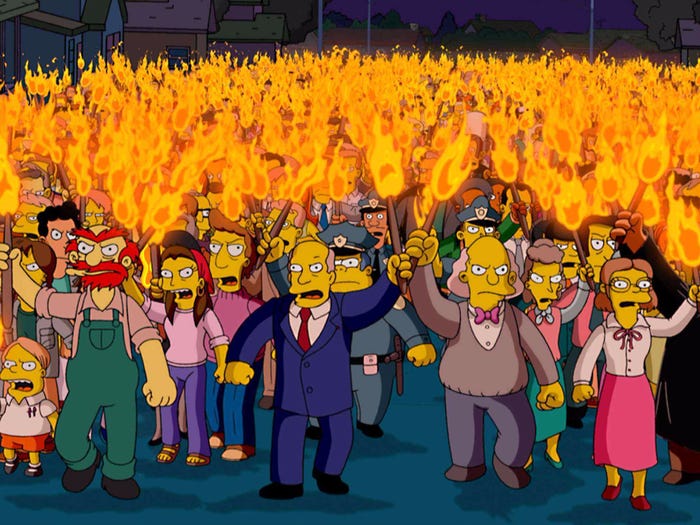
Something troubling has happened to Catholic conversation in America. Over the past year of writing cultural and political commentary, I’ve watched a familiar pattern emerge with depressing predictability. Readers arrive at articles already armed with conclusions, already sorted into camps, already certain of their positions before engaging with a single argument. What follows in comment sections rarely resembles genuine intellectual engagement with Catholic moral reasoning. Instead, we get ritual exchanges of slogans, talking points, and tribal signaling.
This pattern reveals something deeper than ordinary disagreement over policy or prudential judgment. We’re witnessing the collapse of shared intellectual posture among Catholics themselves. The Church’s tradition of careful moral reasoning, rooted in virtue and oriented toward truth, has become foreign territory even for many faithful Catholics. Instead of drawing from our rich intellectual heritage, too many of us read every issue through prepackaged ideological lenses borrowed from secular political movements.
The Binary Trap
Modern discourse forces everything into false binaries that eliminate nuance and complexity. In economics, you either worship unfettered markets or demand totalitarian state control. In racial discussions, you choose between accusatory hypercriticism or complete denial of systemic problems. In politics, you pledge allegiance to partisan identities as if the Gospel arrived demanding a party badge. Media consumption becomes a choice between establishment narratives or conspiratorial theories with little room for discerning truth from either source.
Each domain presents forced choices between extreme positions, and each binary rewards constant outrage. This environment makes Catholic teaching appear suspect and incoherent by default. A writer who insists upon moral limits, historical context, and principled restraint seems bizarre to audiences trained to expect absolutism and inflammatory rhetoric.
The result creates absurd contradictions. The same Catholic author can receive accusations that cancel each other out completely. I’ve been labeled as everything from a racist apologist to a liberal Democrat, from a MAGA extremist to an Obama voter, sometimes within the same week discussing different articles. These laughable contradictions would amuse G.K. Chesterton, though their implications deserve serious consideration.

The Outrage Economy
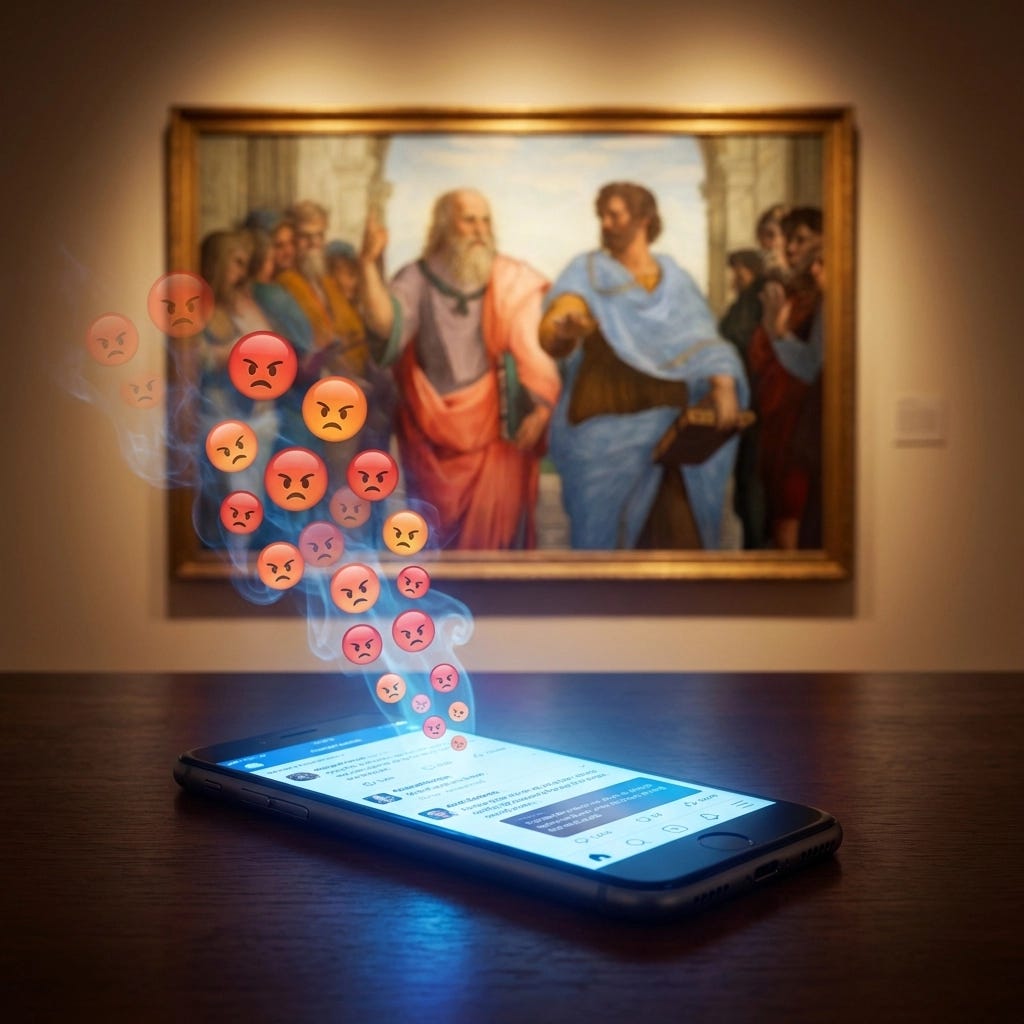
These reactions reveal how deeply polarization has reshaped how people process information. Many readers approach public discourse with conclusions already fixed, scanning articles for confirmation or offense rather than engaging with actual arguments. The content becomes incidental to the emotional reaction it produces.
This dynamic explains the financial success of outrage merchants who understand the economics of attention better than the demands of truth. Figures like certain conspiracy-focused commentators thrive by feeding suspicion in calibrated doses, keeping audiences perpetually agitated and perpetually returning for more content. The model proves lucrative precisely because modern audiences prefer simplified narratives over complex analysis.
Apocalyptic political language amplifies this problem by framing elections and policy debates as final battles between good and evil. Such rhetoric borrows theological imagery while stripping away theological discipline and wisdom. When politics becomes salvation history compressed into campaign cycles, prudence appears weak and compromise seems treacherous.
Scholars have documented how apocalyptic framing dissolves moral restraints by recasting political opponents as embodiments of ultimate evil. Once that shift occurs, ordinary ethical limits lose their authority. History supplies grim examples. Civil War preachers invoked violent psalms to sanctify brutality, convinced they were participating in divine judgment rather than human conflict. The lesson endures: when political identity absorbs sacred meaning, cruelty acquires permission.
The Psychology of Fear
Religious imagery activates archetypal fears that narrow cognitive capacity and simplify complex realities into manageable threats. Fear polarizes communities, eliminates nuance, and elevates strongmen by inviting populations to trade personal agency for promised protection. These conditions create fertile ground for authoritarian postures regardless of ideological label.
Research shows that significant percentages of Catholics hold apocalyptic beliefs that frame politics as zero-sum contests where defeat equals catastrophe. These beliefs correlate with heightened political engagement alongside heightened hostility toward perceived opponents. The implication deserves attention: zeal untethered from prudence tends toward escalation and violence.
American history carries a long tradition of apocalyptic self-understanding, from Puritan visions of a New Jerusalem to more recent invocations of cosmic battles. Such language reappears during moments of upheaval because it offers narrative coherence when events feel chaotic and threatening.
Reclaiming Catholic Virtue
Against this backdrop, Catholic social teaching offers an alternative that appears almost subversive in contemporary culture. The Church insists upon moral reasoning that respects human dignity across political differences, distinguishes eternal truths from temporal strategies, and maintains charity even toward opponents.
The four cardinal virtues provide a framework for recovering authentic Catholic discourse. Prudence calls for pausing before reacting rather than succumbing to knee-jerk responses driven by social media algorithms. Justice demands speaking truth even when it costs us politically or socially. Fortitude sustains our commitment to these principles when we feel tired or tempted to compromise for easier acceptance. Temperance governs moderation in our speech, digital consumption, and emotional reactions to political developments.
St. Francis de Sales offers practical guidance for Catholics seeking to move beyond inflammatory rhetoric. His teaching on virtuous speech emphasizes that our language should remain restrained, frank, sincere, candid, and honest. He reminds us to weigh our words carefully, noting that “the more pointed a dart is, the more easily it enters the body, and in like manner the sharper an obscene word is, the deeper it penetrates into the heart.”
When addressing wrongdoing, Francis teaches us to distinguish between vice and person, avoiding labels based on single actions while condemning harmful behaviors. When we hear accusations against others, we should make them doubtful if we can do so justly, express sympathy for those involved, and remind others that avoiding sin depends entirely on God’s grace rather than human superiority.
The Path Forward
This wisdom feels almost inaccessible in a culture addicted to urgency and immediate gratification. Modern discourse rewards speed, certainty, and spectacle, while virtue requires patience, formation, and humility. Authentic Catholic engagement resists hashtags and demands reading beyond headlines, listening beyond our established allies, and thinking before choosing sides.
Catholics increasingly outsource moral judgment to ideological ecosystems that reward tribal loyalty over truth-seeking. This fragments the faithful into rival camps that speak past one another while claiming the same tradition. Teaching authentic Catholic doctrine under such conditions feels like addressing an audience trained to hear only political dog whistles.
The deeper crisis involves the loss of epistemic virtue among Catholics. We must relearn how to think carefully before aligning with political movements, how to weigh evidence before assigning blame, and how to distinguish prudential disagreements from moral absolutes. Such work begins internally through formation of conscience rather than consumption of outrage content.

Becoming Credible Again
This responsibility extends into public discourse where Catholics can model disagreement without dehumanization and conviction without fanaticism. Such witness appears increasingly rare in contemporary culture, which gives it quiet power. Refusing apocalyptic panic while insisting upon moral truth disorients extremes on both sides, and that discomfort often signals fidelity to authentic Catholic principles.
The irony remains striking. A Church often accused of rigid thinking now stands among the few institutions capable of teaching genuine intellectual proportion and nuance. A tradition caricatured as medieval preserves tools essential for navigating modern complexity. The Catholic understanding of virtue offers freedom from ideological captivity precisely because it demands submission to truth rather than tribal allegiance.
Catholics must become credible again as thinkers, neighbors, and citizens. This credibility flows from grace as much as intellect, and we possess both resources. The obligation rests upon us to lead by example, restoring reason to public discourse and charity to disagreement. Pope Francis reminds us that virtuous speech flows from prayer and careful listening: “Unless we listen, all our words will be nothing except useless chatter.”
The alternative promises endless outrage cycles and ever-shrinking understanding, which serves many interests except the common good. Catholic virtue offers a different path forward, grounded in the cardinal virtues, shaped by saints like Francis de Sales, and oriented toward truth rather than tribal victory. In a culture drowning in manufactured anger, this ancient wisdom appears revolutionary simply because it chooses patience over panic and charity over conquest.
Moving past outrage requires recovering the Catholic intellectual tradition that can hold tension without collapse, engage complexity without simplification, and maintain hope without naivety. These gifts remain available regardless of cultural fashions or political cycles. The question facing Catholics today involves whether we will reclaim this heritage or continue surrendering it to secular ideological systems that promise much yet deliver only division and exhaustion.
Love the article. I appreciate the call to move beyond reflexive political outrage. You are right about one thing immediately: many readers arrive already armed with conclusions, sorted into camps, exchanging slogans rather than engaging in genuine intellectual reflection. That is real. Where I struggle is with the diagnosis you offer to explain it.
You describe this moment as a “collapse of a shared Catholic intellectual posture.” I’m not convinced such a posture ever existed in the way you imply. When I studied theology, what I learned very quickly was that Catholicism has never had a single intellectual tradition but many. Thomists and Augustinians, Jesuits and Franciscans, voluntarists and intellectualists have long argued fiercely with one another. What often passed for “unity” in earlier centuries was not consensus born of persuasion but coherence enforced by institutional power. The Church once possessed mechanisms that sharply constrained public dissent, and that reality shaped how disagreement appeared. The loss of that power has revealed diversity that was always there.
That does not mean the present moment is healthy. But it does mean we should be careful not to romanticize the past. Catholic history includes not only careful moral reasoning and heroic sanctity, but also mobs, violence, ethnic hatred, and grave moral failures carried out by baptized people under clerical influence. Any honest appeal to tradition must reckon with both the Church at her best and the Church at her worst.
Where I agree with you strongly is that Catholics today often borrow their moral and political instincts wholesale from secular ideologies and then baptize them after the fact. Many of us no longer reason from virtue, conscience, and teleology, but from partisan scripts. This is not primarily an intellectual failure. It is a failure of formation.
However, I think you underestimate how much modern technology has changed the moral terrain. Our fragmentation is not simply the result of bad thinking. It is the result of an unprecedented environment of surveillance, algorithmic sorting, and emotional saturation. We do not merely read about suffering anymore. We watch it unfold in real time. We carry war, murder, and humiliation in our pockets. That constant exposure produces moral exhaustion, reactive outrage, and tribal retreat. People are not choosing simplicity because they hate nuance. They are choosing it because the emotional load has become unbearable.
You argue that modern discourse forces us into false binaries. I would suggest something slightly different. Modern systems identify real differences among us and then amplify them relentlessly. Sex, religion, culture, and political identity are not imaginary distinctions. Scripture itself names such divisions. Christianity’s task has always been to reconcile real differences, not to pretend they do not exist. What has changed is that our technologies now predict, reinforce, and monetize those differences with astonishing precision.
This is why moments of violence and injustice feel so explosive. We are no longer distant observers. We are witnesses. We watch events unfold through raw, unfiltered images, and our consciences respond viscerally. That reaction is not evidence of moral collapse alone. It is evidence that people still feel deeply. The danger is not outrage itself, but outrage unformed by virtue, truth, and courage.
I also think you misidentify the central threat. The crisis we are living through is not chiefly a breakdown of Catholic intellectual tradition. It is a broader collapse of moral authority in a world drifting from rules-based order toward naked power. Strongmen, propaganda, and spectacle are filling the vacuum left by shared norms. Young people sense this intuitively, which is why so many drift toward extreme ideologies. They are not stupid. They are searching for meaning, structure, and belonging in a world that feels predatory and incoherent.
In that sense, I agree with you that virtue formation is essential. Prudence, temperance, justice, and fortitude matter more than ever. But virtue alone, spoken abstractly, will not suffice. We also need the courage to name evil clearly. To say that something is wrong. To refuse to laugh at cruelty. To insist that conscience still matters, even when the crowd cheers otherwise.
The outrage economy will not be dismantled by polite essays alone. Nor will it be healed by nostalgia for a unity that never fully existed. What we are witnessing may be something more like a moment of religious and moral reconfiguration. When societies become unstable, people do not stop believing. They believe more intensely, often in distorted ways. If Christianity does not speak credibly to this moment, others will fill the void.
So I share your concern. I share your desire for deeper formation and less reactionary politics. Where I challenge you is this: do not reduce this crisis to intellectual decline alone. This is a human, technological, and moral reckoning happening in real time. If Catholicism has anything to offer now, it must be honest about its own history, serious about naming evil, and brave enough to speak with clarity rather than comfort.
Forming ourselves in virtue is necessary. But so is truth telling. And so is courage.
Our mission is not to win the outrage economy but to bear witness to a Kingdom not of this world. In choosing prayer, charity, and hope, we exchange anxiety for fidelity and noise for the enduring peace of Christ.