
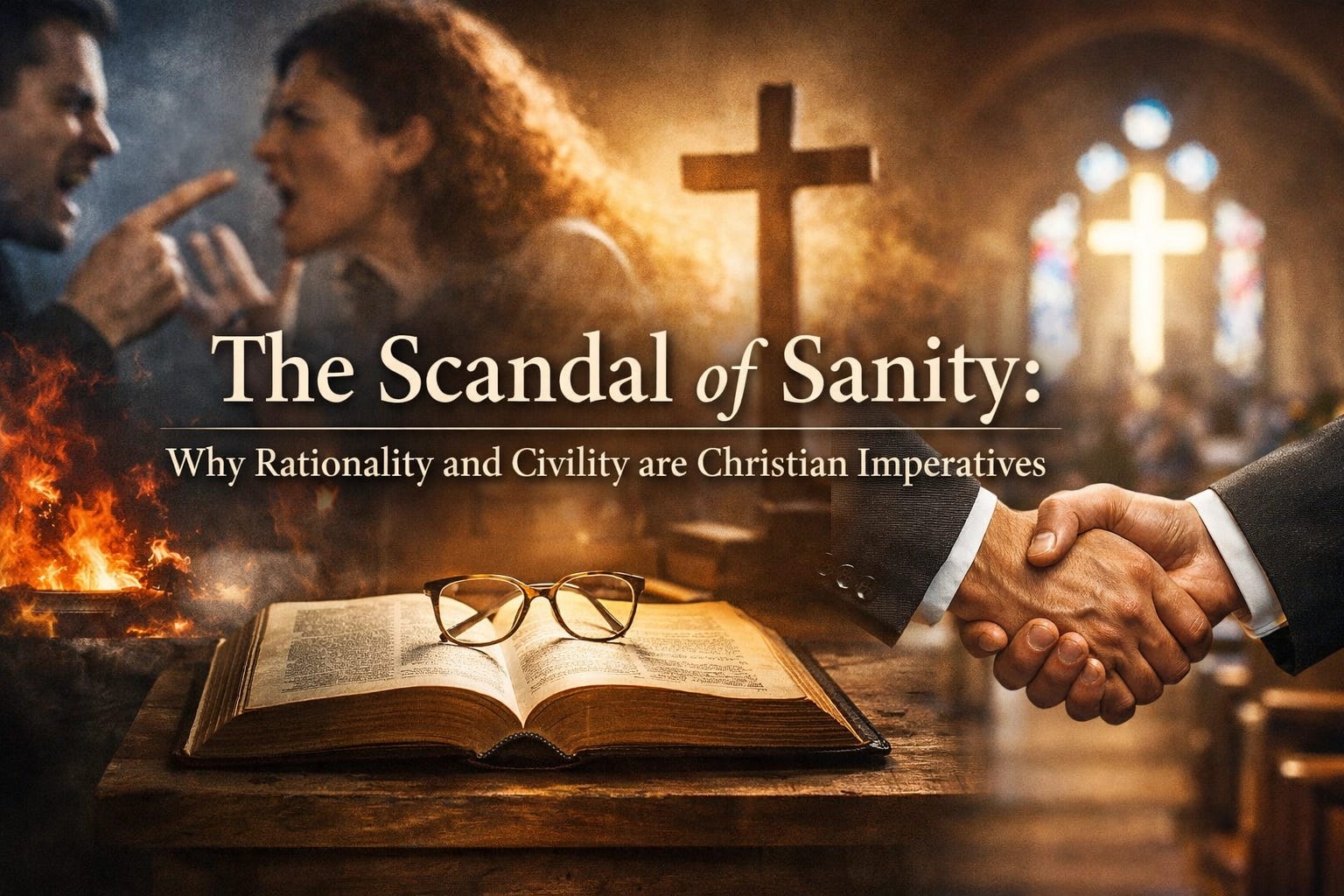
The Scandal of Sanity
Why Rationality and Civility are Christian Imperatives

Robbie George, the legal philosopher, wrote a post on social media I’d like to comment on. Here is what he wrote:
“Hello there friends and neighbors! This is your periodic reminder that there is nothing in sacred scripture that requires you to allow President Donald J. Trump to make you crazy. Whether you are for him or agin’ him, you are not required to let him cause you to forget or abandon your principles, to turn against what you once believed, or to become an ideologue who simply reacts to him pro or con. You are not required to oppose what he supports because he supports it, to support what he supports because he supports it, to support what he opposes because he opposes it, or to oppose what he opposes because he opposes it. You are not required to vilify his supporters because they support him or vilify his opponents because he opposes them. What you are required to do is to think independently ... and rationally. You are required to exercise discernment and judgment--and control your emotions (again, whether you are pro-Trump or anti-Trump). You are required to treat people who do not see President Trump--or politics in general--as you do, as civic friends, despite your disagreements with them, and not as enemies to be destroyed. And, of course, you are required, we are all required, to acknowledge--deeply, existentially, and not merely notionally--our own fallibility. We’re not going to be right about everything. We might be wrong about a lot of things. We might be wrong about some very, very important things--things we deeply care about. So we need to listen to our fellow citizens with whom we disagree, engaging them in a truth-seeking spirit. That’s what civility actually is. It’s more than merely being polite (though it would help if people would at least be a bit more polite). End of sermon.”
Robert P. George is a figure of immense intellectual stature whose contributions to the fields of legal philosophy and natural law have shaped public discourse for several decades. As a distinguished professor at Princeton University, he has navigated the highest echelons of academia while remaining a steadfast defender of the moral reasoning necessary for a functioning republic. Hence why this commentary matters. His post was almost immediately met with explosive reaction.
The speed with which his appeal to moderation ignited fury provides clear evidence of a culture currently drowning in emotional saturation. We inhabit an age where the capacity for cool deliberation appears increasingly rare, replaced by a reflex that recasts every prudential disagreement as a catastrophic moral failing. When a scholar suggests that we should avoid vilifying those with whom we disagree, the ensuing outrage reveals a profound sickness within the body politic. This phenomenon suggests that many citizens have allowed their emotional responses to bypass their cognitive faculties entirely, leading to a state where feelings serve as the ultimate arbiters of truth.

The Biblical Mandate for a Disciplined Mind
A robust biblical anthropology recognizes the human person as a creature endowed with both reason and will, yet modern political engagement often encourages the abandonment of these divine gifts. Saint James offers a stern warning in his epistle, noting that the anger of man fails to produce the righteousness of God, a principle that applies directly to the vitriol found in contemporary social media threads. To follow the path of Christ requires a commitment to being transformed through the renewal of the mind, as Saint Paul commands in his letter to the Romans. This transformation implies a disciplined intellect that refuses to succumb to impulsive reactions or tribalistic fervor.
Our Lord Himself insisted that true worship occurs in spirit and truth, a standard that necessitates an objective adherence to reality rather than a surrender to the intensity of one’s feelings. Whenever we permit our political loyalties to dictate our perception of what is true, we risk falling into a form of secular idolatry that obscures the light of the Gospel. The call to think rationally remains a thoroughly biblical imperative because God is the source of all reason; therefore, the pursuit of truth requires us to exercise the discernment He has provided. When we lose our ability to engage in civil discourse, we simultaneously lose our ability to bear witness to the Logos who ordered the universe with wisdom and purpose.
Conscience and the Judgment of Reason
The Catechism of the Catholic Church provides a necessary corrective to the idea that conscience serves merely as a vessel for personal sentiment or subjective preference. Within its pages, conscience is defined as a judgment of reason whereby the human person recognizes the moral quality of a concrete act. This definition places the intellect at the center of the moral life, emphasizing that a well formed conscience relies upon the discovery of objective goods through the exercise of the mind. Far from being a surge of emotion, the conscience functions as an act of practical intellect ordered toward the flourishing of the person and the community.

When outrage displaces reason, the conscience begins to atrophy into a tool for mere self expression, which creates a spiritually dangerous environment for the individual and a corrosive atmosphere for the state. If we fail to ground our political convictions in the soil of rational inquiry, we become susceptible to every wind of demagoguery that sweeps across the digital landscape. Reality bats last, and any society that attempts to build its foundation on the shifting sands of collective emotion will eventually find its structures collapsing under the weight of its own inconsistencies. Maintaining the integrity of the conscience requires a commitment to the truth that transcends the fleeting passions of the election cycle.
The Thomistic Virtue of Prudence
Saint Thomas Aquinas, the Angelic Doctor, understood that virtue perfects both the intellect and the will, enabling a person to judge rightly and choose accordingly in the complexities of life. He identified prudence as right reason in action, the specific virtue that governs the application of universal moral principles to the contingent and often messy circumstances of political life. Prudence demands that we move beyond mere appetite and allow reason to govern our choices so that our actions correspond to the objective good. In our current climate, however, prudence is frequently exiled in favor of the spectacle, as citizens demand immediate and absolute moral verdicts on every headline.
Most political questions reside within this realm of prudential judgment, meaning that people of good will might disagree on the best methods for achieving a shared goal. For instance, debates over immigration levels, fiscal priorities, or foreign policy often involve competing goods that require careful weighing rather than simplistic moral posturing. When we treat every policy disagreement as a sign of heresy, we abandon the Thomistic tradition that honors the complexity of human governance. A recovery of prudence would allow us to view our political opponents as civic friends who may be wrong about a particular strategy while still sharing a desire for the common good.

Disordered Loves and the City of Man
Saint Augustine famously described earthly societies in his work The City of God as groups of people held together by the things they love. If a population prizes domination and pride above all else, they will inevitably build an empire defined by those characteristics; conversely, if they love justice under God, they will work toward a more stable and virtuous commonwealth. Our current social disorder reveals a collection of disordered loves, where many have fused their personal identities so thoroughly with partisan alignments that any critique feels like a personal assault. In this environment, political leaders cease to be mere public servants and instead become avatars of existential meaning for their followers.
This fusion of identity and politics creates an unstable foundation for republican government because it transforms every election into a liturgical event of cosmic significance. When we look to the state or a specific leader to provide the fulfillment that only God can offer, we fall into a trap that historically leads to tyranny or social collapse. The Church proposes a different path, one where our primary allegiance belongs to the Kingdom of Heaven, allowing us to engage in earthly politics with a sense of perspective and humility. By ordering our loves correctly, we gain the freedom to critique our own “side” and to recognize the truths present in the arguments of our adversaries.
The Trap of Identity Politics
Modern psychological insights, such as those presented by Jonathan Haidt, confirm the ancient wisdom that our moral reasoning often functions as a press secretary for our intuitive, emotional reactions. If we allow these immediate responses to rule our lives without examination, we become the very ideologues that Robbie George warned against in his post. There exists a faction within our present divide that openly resents the concept of shared civic virtue, preferring to deploy moral language strategically to sanctify their own outrage. In this framework, compassion becomes a weapon, and justice is recast as a tool for perpetual grievance against those outside the chosen tribe.
Identity politics thrives on these binary narratives and emotional mobilizations because they simplify the world into a drama of heroes and villains. This mindset reduces complex social questions to slogans, leading to a collapse of genuine deliberation under the weight of constant suspicion. More than skin color, our shared humanity and our shared identity as children of God should provide a basis for discourse that transcends tribal boundaries. Catholic moral theology resists the distortions of identity politics by affirming that truth remains objective and accessible through reason, regardless of one’s demographic or political affiliation.

The Cross as the Ultimate Corrective
The definitive corrective to the emotive absolutism of our age is found at the foot of the Cross, where the pride of man is laid bare before the wisdom of God. When we encounter Christ, who is the Logos or divine Reason, we are confronted with a truth that refuses to conform to our personal preferences or partisan agendas. He conforms our hearts to the truth through His grace, a process that frequently involves the discomfort of exposing our own illusions and disrupting our tribal loyalties. This transformation demands repentance and intellectual humility, yet it ultimately leads to the liberation of the soul from the tyranny of its own passions.
Truth often wounds our pride before it begins the work of healing, and it frequently unsettles the cherished assumptions that we hold most dear. Such discomfort serves as evidence of spiritual growth rather than oppression, inviting us to look beyond our immediate reactions toward the eternal light of God’s law. If we could recover this disposition of humility, the temperature of our public discourse would gradually cool, allowing outrage to yield to the patient work of deliberation. We must refuse to absolutize any political figure or movement, keeping our eyes fixed on the only One who can truly save us and our society.
Only when we submit our passions to the Lord will our politics recover the sanity necessary for authentic human flourishing. We are called to treat our fellow citizens as neighbors to be loved rather than as enemies to be destroyed, seeking the common good with a spirit of charity and truth. Through the cultivation of prudence and the exercise of disciplined reason, we can move beyond the scandal of outrage and toward the peace that surpasses all understanding. Our mission as Christians involves the evangelization of the culture with the light of the Gospel, demonstrating that a life lived in accordance with natural law and sacred scripture offers the only path to a truly just and civil society.
Read About me and my work. May we find a consistent call to return to these fundamental truths in an age of confusion.