

Renee Good, ICE, and the Demand of Christian Virtue
Rejecting Tribalism and Embracing Virtuous Justice

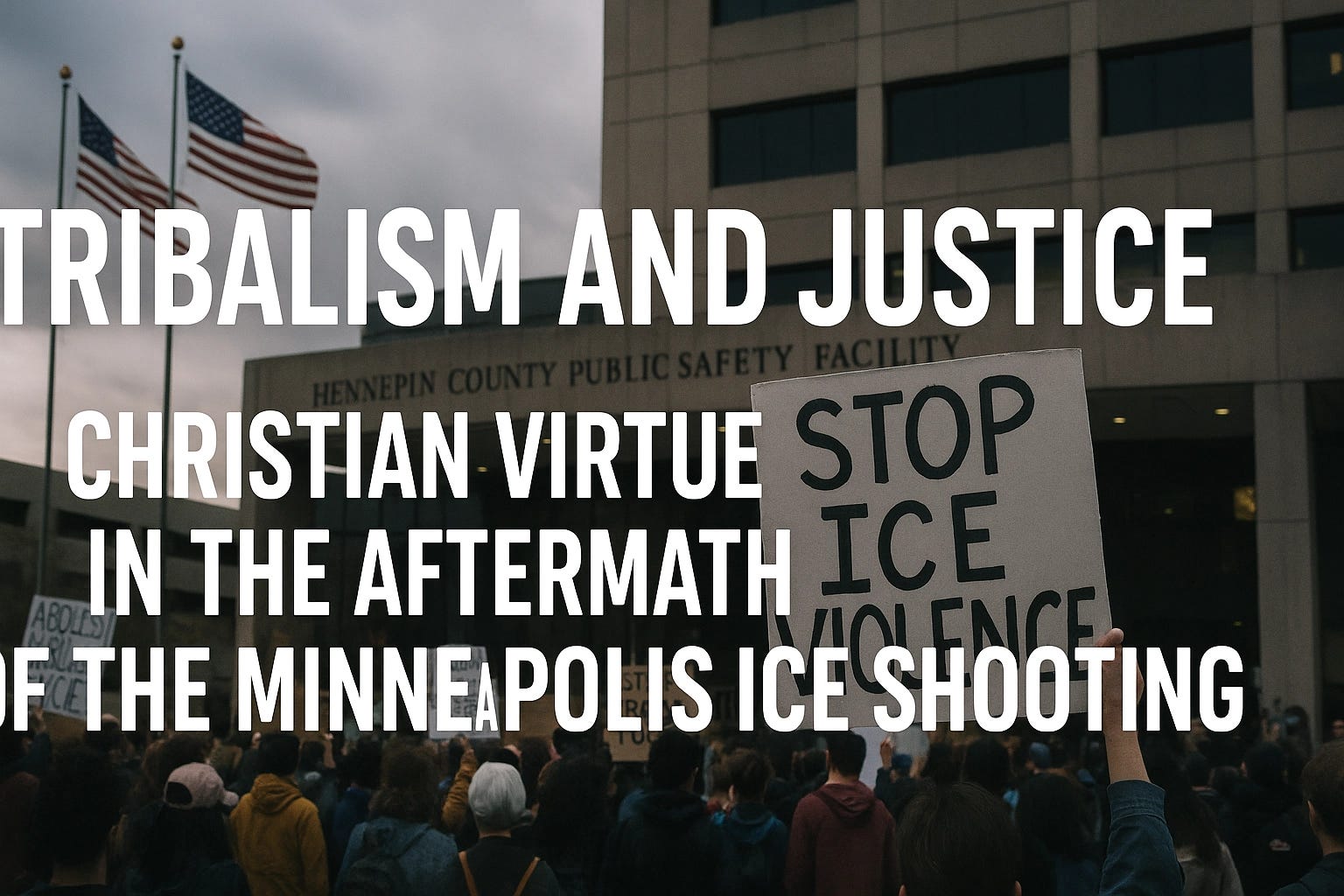
Last week, the fatal shooting of 37-year-old Renee Good by an ICE agent in Minneapolis ignited the predictable firestorm of tribal reactions, political posturing, and social media fury. Within hours, camps had formed, narratives had solidified, and the opportunity for genuine moral reflection had largely evaporated. As Christians navigating a deeply polarized culture, we face a profound question in moments like these: How do we respond with virtue, wisdom, and the love of Christ rather than joining the chorus of knee-jerk outrage?
The Facts and the Fury
According to the Department of Homeland Security, Renee Good allegedly attempted to flee federal agents and struck law enforcement officer Jonathan Ross with her vehicle, causing internal bleeding to his torso. The agent discharged his weapon in response to this threat. Good, a U.S. citizen who had just dropped her six-year-old son off at school, died from her injuries. Minneapolis Mayor Jacob Frey offered a competing narrative, suggesting she was merely trying to leave the situation. The political class quickly mobilized, protests erupted, and another American tragedy became fuel for our ongoing culture war.
The Christian response to such events must resist the gravitational pull of tribal allegiance. We can mourn the death of Renee Good, pray for her grieving family, and feel deep sorrow that a child lost his mother. Simultaneously, we must acknowledge the evidence that suggests she disobeyed lawful orders from federal agents and endangered the life of a law enforcement officer by using her vehicle as a weapon. These realities coexist, and Christian moral reasoning requires us to hold them together rather than choosing sides based on ideological convenience.
Honoring Just Law and Those Who Enforce It
Scripture speaks with remarkable clarity about the Christian’s relationship to civil authority. In Romans 13, the Apostle Paul instructs believers that governing authorities have been established by God and that those who resist authority resist what God has appointed. This passage has generated centuries of theological reflection, and the Church’s consistent teaching affirms that just laws deserve obedience and that those who enforce just laws deserve honor and respect.
The immigration enforcement actions undertaken by ICE represent the execution of laws passed through legitimate democratic processes. Reasonable people may debate immigration policy, advocate for reform, and work through proper channels to change laws they consider unjust. The Christian tradition allows space for such engagement. What virtue prohibits, however, is the reflexive vilification of law enforcement officers performing their lawful duties or the celebration of those who resist lawful authority through dangerous means.
The officer involved in this incident, Jonathan Ross, suffered serious injuries while performing his job. He has a family, a life, and a vocation that places him in harm’s way for the sake of public order. Christian charity demands that we extend compassion to him as readily as we extend it to Renee Good. The tribal impulse to canonize one party while demonizing the other represents a failure of moral imagination and a departure from the Gospel’s universal call to love.
A Personal Testimony
I write these words as a black man and as an immigrant to this nation. My entire life, I have understood a simple truth that has served me well in every encounter with law enforcement: obedience to lawful authority and courteous, respectful conduct dramatically reduce the likelihood of escalated confrontations. This wisdom came from observation of the minority culture I was raised in. I learned very early that regardless of any injustices that may exist in systems and institutions, my personal conduct remains within my control and my moral responsibility. I also learned how nonsensical retaliation to law enforcement is quickly escalated into tragic consequences.
Has every encounter been pleasant? Of course not. Have I witnessed or experienced moments where officers acted with less than perfect professionalism? Certainly. Yet the overwhelming majority of my interactions with police, immigration officials, and other authorities have proceeded without incident precisely because I approached them with respect, compliance, and courtesy. This pattern holds true across countless communities and millions of daily interactions between citizens and law enforcement that never make headlines because they unfold without drama.
The virtue of respectful obedience to lawful authority deserves urgent rehabilitation in our cultural moment. Parents must teach their children, from the earliest ages, how to interact safely and appropriately with police officers and other officials. This teaching represents an act of love, a practical protection against tragedy, and a formation in civic virtue that strengthens the entire social fabric. The alternative, which celebrates resistance and frames every police encounter as oppression, places young people in genuine danger while undermining the conditions necessary for ordered liberty.
Acknowledging Imperfection Without Abandoning Principle
Christian doctrine acknowledges that human institutions remain marked by sin and that abuses of authority occur. The Church has never taught blind obedience to every command of every official, and the tradition recognizes that unjust laws may, under certain carefully defined circumstances, be legitimately resisted. History provides sobering examples of state power wielded for evil purposes, and Christians must remain vigilant against genuine tyranny.
Yet this acknowledgment cannot become a blank check for lawlessness or a justification for treating every exercise of legitimate authority as oppression. The vast majority of law enforcement officers in this country perform their duties honorably, often at great personal sacrifice and risk. They deserve the presumption of good faith that we would extend to practitioners of any other profession. When specific officers commit specific wrongs, appropriate accountability mechanisms exist to address those failures. The answer to occasional abuse lies in reform and accountability rather than wholesale rejection of law enforcement’s legitimacy.

The Call to Holiness Over Outrage
The deeper invitation in moments like the Minneapolis shooting extends beyond policy debates and political positioning. Christians face a spiritual challenge: Will we allow the outrage economy to colonize our hearts, or will we cultivate the virtues necessary for genuine moral reasoning and charitable engagement?
Outrage feels satisfying in the moment. It provides a sense of righteousness, tribal belonging, and moral clarity. Yet outrage as a habitual posture corrodes the soul and distorts our capacity to see others as fellow image-bearers of God. The person who approaches every news story already certain of its meaning, already armed with talking points, already sorted into camps, has surrendered the intellectual humility and openness to truth that Christian discipleship requires.
As I have written previously, the collapse of shared intellectual posture represents one of the gravest challenges facing our culture. Catholics and other Christians possess resources uniquely suited to this disorder. We inherit an intellectual tradition capable of holding tension without collapse, a Scripture that teaches discernment rather than hysteria, and a grace that enables transformation beyond mere willpower.
Moving Forward in Love
Renee Good’s death deserves mourning. A human person is now dead. Her son’s loss deserves our prayers. The injured officer also deserves our concern and gratitude and prayers. The complex questions surrounding immigration policy deserve thoughtful, good-faith debate. What none of these realities deserve is the reduction of a human tragedy to tribal ammunition or the abandonment of Christian virtue for the cheap satisfactions of political outrage. Christ demands that we be better.
The path forward requires us to speak the love of Christ, pursue justice through legitimate means, teach our children the virtues that preserve both their safety and their integrity, to respect and honor just law enforcement, and to resist the temptation to canonize or demonize based on ideological allegiance. This calling demands more of us than the culture offers, and that difficulty signals its worth.
May we become Christians worthy of the name, formed in virtue, guided by holiness, and committed to the love that transforms rather than the outrage that destroys.
Excellent. Yes. 🙏🏼🩷