
The Significance of Ashes and Dust
Why Ash Wednesday Forces Us Into Death and New Life

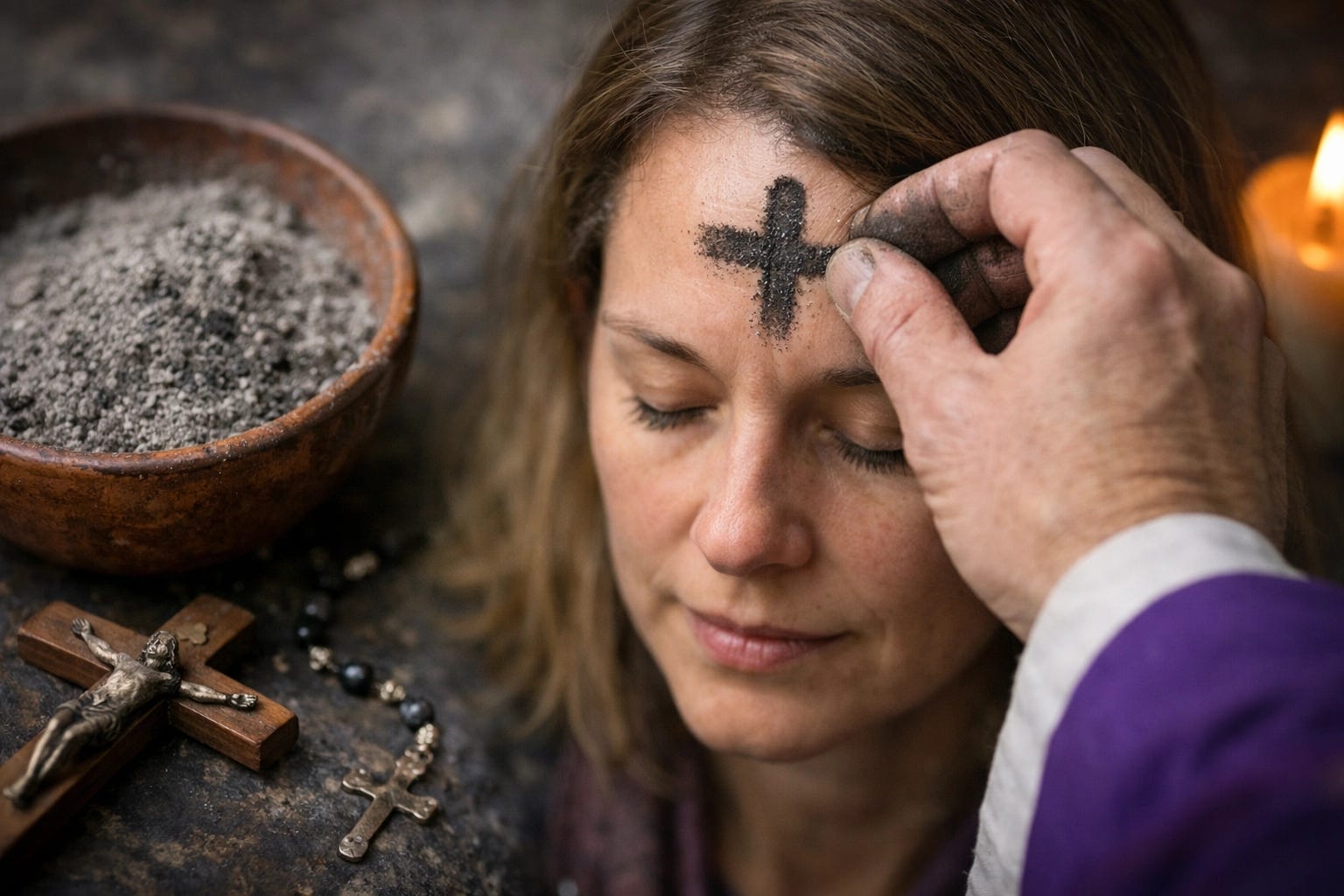
Ash Wednesday is today, and the Church will mark millions of foreheads with last year’s palms while the internet runs its yearly argument about sincerity. I get it, because everyone is tired of performative everything, and yet the ashes are painfully simple, since they say what Abraham said when he stood before the Lord: “Behold, I have taken upon myself to speak to the Lord, I who am dust and ashes” (Genesis 18:27). Ash Wednesday is less a spiritual aesthetic and more an honest admission that I am small, I am mortal, I am accountable, and God remains God.

The Hebrew Grammar of Humility
Ashes have a vocabulary in Scripture, and it stays stubbornly physical. The Bible keeps bringing repentance down into the body, which makes sense since covenant life happens in time, in history, in public, and in the presence of a God who speaks with authority and heals with mercy. Abraham’s line sets the baseline, since humility starts with reality: “Behold, I have taken upon myself to speak to the Lord, I who am dust and ashes” (Genesis 18:27).
Job takes it even further, and the scene is raw, since he “sat among the ashes” (Job 2:8), and later he says, “Therefore I despise myself, and repent in dust and ashes” (Job 42:6). Ashes are what you do when the arguments run out, the spin dies, and you finally tell the truth to God.
This shows up as public repentance all over the Old Testament. Mordecai “put on sackcloth with ashes” (Esther 4:1) when the decree of death hit, and Daniel “turned to the Lord God, pleading in earnest prayer, with fasting and sackcloth and ashes” (Daniel 9:3) when he read the covenant story and realized Israel had wandered. Ashes are confession in a form you can see, which is why the Church stays unembarrassed about putting it on the forehead.
The Geography of Grief and Restoration
Ashes also show up in the life of a community, which matters because faith has always had a public side. The Mishnah describes communal fast days where they brought ashes and placed them “upon the ark” and on the heads of the leaders, and then each person placed ashes on his own head (Mishnah, Ta’anit 2:1). That is Israel admitting, together, that the problem is bigger than the weather and deeper than politics, since the real issue is always the heart.
Jesus taps that same Jewish vocabulary when He rebukes unrepentant cities, since He says they would have repented “in sackcloth and ashes” (Matthew 11:21). He treats ashes as a sign of metanoia, and He treats repentance as an actual turn, which means a person returns to God in mind, in choices, in public life, and in private life.
Covenant theology sharpens what ashes mean because covenants carry blessings and curses, and that story is practical rather than abstract. When the covenant is honored, the land yields. When the covenant is violated, the land dries, enemies rise, and exile follows. Daniel’s ashes belong to that story, and the ashes on Ash Wednesday belong to the same logic, even when the setting is a parish in suburban Detroit.
There is another layer that deserves more attention, since Torah uses ashes for purification as well as repentance. Numbers 19 gives the red heifer rite, and the text is plain: “a man who is clean shall gather up the ashes of the heifer, and deposit them outside the camp in a clean place; and they shall be kept for the congregation of the people of Israel as water for impurity: it is a sin offering” (Numbers 19:9). Leviticus also treats ashes as part of the priest’s faithful work, since “he shall put on his linen garment... and he shall take up the ashes” and then carry them “outside the camp” (Leviticus 6:10-11). That combination teaches something simple, since God deals with sin and death in the open, and God also provides a path back to worship.
That detail keeps ashes from sliding into despair, since biblical repentance aims at restoration. When God calls for return, He calls for a real return: “Return to me with all your heart, with fasting, with weeping, and with mourning” (Joel 2:12).
Christ and the Covenant Curse
All of this clicks into place when you read it through Christ instead of reading it as a religious mood. Hebrews does the heavy lifting: “For if the sprinkling of defiled persons with the blood of goats and bulls and with the ashes of a heifer sanctifies for the purification of the flesh, how much more will the blood of Christ... purify our conscience from dead works to serve the living God” (Hebrews 9:13-14). The ashes were real. The cleansing was real. The fulfillment is personal, since Jesus gets under the weight for real sinners in the real world.
That takes you straight to the Cross, where Scripture refuses to soften the language: “Christ redeemed us from the curse of the law by becoming a curse for us, for it is written, ‘Cursed is everyone who is hanged on a tree’” (Galatians 3:13). Ash Wednesday lands where the Gospel lands, since repentance is a return to the One who paid the bill.

Ashes also keep me honest, because I can talk about renewal while dodging confession, and I can call it growth. The ash on the forehead interrupts that game, and it pushes me back toward the mercy that actually changes a person.
Living Covenant Life in 2026
Ash Wednesday in 2026 is a gift, since it hands me the truth without drama. I am dust, and God is God, and grace is real, and the goal is a clean heart that wants what God wants. The hope stays strong, since the same Lord who exposes also promises, “Behold, I make all things new” (Revelation 21:5), and that is where Lent is headed if I stay with it.
I also want to place in your hands the tools to walk through this Lenten season with clarity and courage. Head to avemariaradio.net and sign up for my daily Lenten mission, a series of free two-minute videos produced together with Ignatius Press and the Catholic Study Bible App, each one designed to help you meditate on the day’s lessons for Lent. Moreover, I want to offer you a free copy of my ebook, Lavished in Love, a day-by-day meditation for the season of Lent published by En Route Media, since many people need something bite-sized, faithful, and steady enough to carry them through the whole season.

Our ashes point beyond my forehead to His Crown of thorns, and they also point forward to resurrection life, since Jesus never calls us to repentance for the sake of staying down.